


















































Posted: by The Alt Editing Staff
The Alternative is 100% supported by our readers. If you’d like to help us write about more great music and keep our site going, you can become a Patron on Patreon, which also allows you to receive extra content, sweet perks, and The Alternative merch, with levels starting at only $2 per month. Everything helps, and if you can’t afford to donate, consider sharing this article and spreading the word about our site! And if you want The Alternative delivered straight to your inbox every month, sign up for our free newsletter. Either way, thanks for reading!

There is something so intrinsically nostalgic about the latest Slow Pulp record that I find myself overcome, pacing around, trying to make sense of it with my head in my hands. This record transports me back to teenage days in a way that is otherwise exclusively accomplished by music I listened to as a teenager. Some of the songs, notably “Yellow and Green,” are quite explicitly about teenage memories; “Dumb and nineteen / Did you think that I would forget about it now?” sings vocalist Emily Massey.
How can brand-new music conjure such a palpable feeling of the past? It speaks to the immense talent of Slow Pulp as a band, and of Emily Massey and Henry Stoehr as songwriting partners. From the first rich, ripe notes from a warm-toned guitar on “Yellow and Green,” the album carries an acute sense of early-autumn nostalgia, containing both a youthfulness and a heaviness, an implicit heartache even before the meaning of the lyrics sink in.
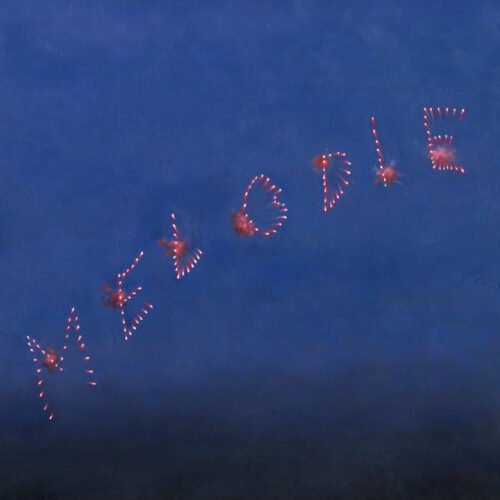
If “Yellow and Green” is an elegy, “Melodie,” the title track, is a romp. Listening to “Melodie” for the first time reminded me of when it was still special and thrilling to be in a car with my friends and no adults. It reminded me of freshness and abandon and dynamism. And it reminded me of Blue Rev by Alvvays, who in fact had Slow Pulp open for them on their Blue Rev tour. I felt the Alvvays influence in other places on the record as well, especially in the reflective wistfulness of “Not for Nothing,” and in the buzzy, shoegazey guitar of “Red Car.”
Slow Pulp’s particular brand of fuzzy power-pop is on full display in lead single “Better Man,” a burst of shimmering ‘90s-esque alt-rock. (It reminds me, for some reason, of “Blessing” by Alex G.) The sound of the hook and chorus have percussive stabs like low-millivolt shocks to the system. “Not for Nothing” marks a shift to a slower tempo, forming a deep and somewhat mournful reflection on the paths not taken. “But what I see looking in your eyes,” sings Massey, “A million miles, a million lives.” The song is about letting go of someone, but it prompts reflection of one’s own youth, when the possibilities were endless, and the fact, equally overwhelming and exhilarating, that anything could happen, that there were a million paths to choose from.
There is so much more to discuss about the album, like the beautiful melodic hooks of “Red Car,” or the banjo-inflected “These Days”—bold title, certainly, but the band pulls it off. But my attention is drawn back again and again to the clarity and the yearning on the record, with “Spill,” plaintive and direct (“Would you tell me that you love me,” sings Massey on the chorus, “Say it out loud?”), and “Up to You,” which captures the helplessness of scrambling after something—or someone—already gone, with an otherworldly ambient dreaminess reminiscent of Cocteau Twins.
The album ends with “Slip Away,” a more minimalist arrangement consisting of just Stoehr’s guitar and Massey’s vocals. The simple music makes space for the rawness of the lyrics, a meditation over the deep sadness of transformation: “And everything feels easy / When I forget that everything is different / When it’s over.” The song is a crystal of sorrow dipped in gold. It is a relief to forget that everything is different, but it is sad to realize it, too.
I have been mulling over these questions for years: how do we reflect on change without sadness? How do we recognize what is new without acknowledging the deep sting of what has been lost? I think often of a line from St. Augustine’s Confessions: behold how these things pass away so that others may succeed them, and the low universe comes together in all its parts. It does not solve my questions, but it comforts me. I do it a disservice by using it as my Twitter bio.
Melodie is one flawless track after another. The music is almost too good to listen to alone, almost too emotional to be shared with others. How should we treat the insoluble problems of youth, the intrinsic pain of the past? We cannot return to those days again, but we can rekindle the feelings and thoughts of our younger selves, and we can continually form new meanings as we do so. A million miles, a million lives. The low universe comes together in all its parts.
Disappointing / Average / Good / Great / Phenomenal
Melodie is out now.
––
Elizabeth Piasecki Phelan | @onefellswoop
Want even more great music and artist interviews from The Alternative??? Sign up to our email list at the link:https://xx2szz.subscribepage.io!